

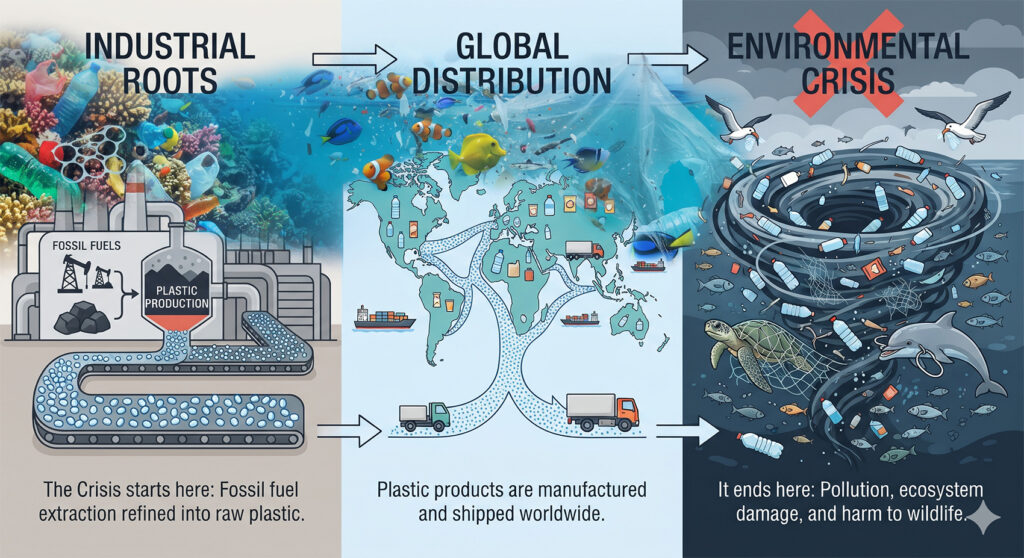
When we picture plastic pollution, our minds naturally wander to the end of the pipeline: a choked stormwater drain overflowing during a sudden monsoon cloudburst, a tangled polybag snagged on a riverbank, or colorful packaging washing ashore on a pristine beach. Yet, fixating solely on the discarded wrapper tells only a fraction of the story. To truly comprehend the scale of our synthetic era, we must trace the plastic lifecycle back to its turbulent genesis: the petrochemical industry.
Long before a single-use container reaches a household bin, its existence is forged in high-heat industrial refineries. The environmental footprint of mass plastic manufacturing is carbon-intensive, geographically pervasive, and inextricably linked to the escalating climate emergency.
I. The Fossil Fuel Umbilical Cord: Born from Petroleum
Plastic is not an organic byproduct of nature; it is a synthetic polymer engineered entirely from fossil fuels—primarily crude oil and extracted natural gas.
The Extraction Toll: The journey begins deep underground through drilling and hydraulic fracturing. This initial extraction phase releases colossal quantities of methane—a greenhouse gas with a warming potential far surpassing carbon dioxide over the short term—while permanently fragmenting fragile ecosystems.
The Cracking Furnaces: Raw hydrocarbons are channeled into sprawling petrochemical complexes to undergo “thermal cracking.” This energy-intensive industrial process breaks hydrocarbon chains apart at extreme temperatures to yield basic polymer building blocks like ethylene and propylene. The sheer thermal demand makes plastic manufacturing one of the most energy-heavy sectors on the planet.
II. The Atmospheric Burden: A Heavy Climate Footprint
The sheer volume of global plastic production creates an immense, invisible atmospheric burden that accelerates planetary warming.
Global Emissions Share: Lifecycle assessments reveal that the extraction, refining, and polymerization of plastics account for roughly 3% to 5% of global greenhouse gas emissions.
The 2050 Trajectory: With global production surging past 400 million tonnes annually—and projected to multiply under business-as-usual scenarios—analysts warn that plastics could claim up to 15% to 20% of global oil consumption, devouring critical global carbon budgets by mid-century.
III. Industrial Fallout: Air, Water, and Frontline Communities
The chemical alchemy of converting fossil fuels into malleable resins does not happen in a vacuum. Industrial manufacturing corridors leave deep, lasting scars on surrounding air and water tables.
- Toxic Airsheds: Refineries and processing plants vent volatile organic compounds (VOCs), benzene, sulfur dioxide, and nitrogen oxides into the atmosphere, blanketing nearby communities in smog and driving severe respiratory and systemic health risks.
- Watershed Disruptions: Chemical synthesis demands immense volumes of cooling water, which frequently re-enters local watersheds carrying heavy metals, catalytic residues, and toxic additives, threatening regional aquatic ecosystems and drinking water security.
- The Invisible Nurdle Epidemic: Before finished goods ever take shape, millions of tons of raw plastic are transported as microscopic resin pellets known as “nurdles.” Accidental transit spills and facility runoff regularly discharge billions of these pellets into storm systems, where they drift out to sea, mimicking food for marine wildlife.
IV. Designed for Obsolescence: The Linear Economy Trap
The core architecture of the mass plastic industry relies on a relentless linear economy: extract, manufacture, utilize for mere seconds, and discard.
Nearly 40% of all synthesized plastics are funneled directly into packaging—materials explicitly engineered for instantaneous disposal. Because virgin plastic resin remains artificially inexpensive to produce (heavily cushioned by legacy fossil fuel subsidies), manufacturers have zero economic incentive to design for true circularity or enduring reuse.
V. Redefining the Solution: From End-Pipe Cleanup to Upstream Accountability
Tackling the synthetic crisis cannot remain solely the burden of grassroots cleanup campaigns. While community collection drives, source segregation, and digital QR-tracked recycling networks are vital for intercepting waste before it infiltrates our rivers and cities, true systemic transformation demands accountability at the industrial source.
Enforcing Extended Producer Responsibility (EPR): Mandating that polymer manufacturers finance and manage the end-of-life collection, sorting, and recycling of the exact tonnage they introduce into commerce.
Accelerating Material Innovation: Transitioning capital investment away from virgin fossil polymers and toward genuinely biodegradable, bio-based alternatives.
Closing the Loop: Reinvesting heavily in mechanical and chemical recycling infrastructure to ensure existing polymers remain within a closed-loop circular economy rather than driving continuous extraction.
The battle for our rivers, cities, and oceans is not won at the curb alone—it begins by challenging the industrial systems that dictate the plastic lifecycle from the ground up.